A lot of people don’t connect their symptoms to trauma straight away. What they notice first is usually something else. Sleep feels different. They wake up tired. Everyday frustrations seem harder to manage than they once were. Some become more withdrawn. Others find themselves reacting more strongly to situations that never used to bother them. Family members sometimes notice the change before they do. Months can pass before they stop and wonder whether these changes started after a particularly difficult experience. That is one reason why PTSD Awareness Month 2026 remains relevant. Many people carry the effects of trauma quietly. They continue showing up for work, looking after their families, meeting responsibilities, and doing everything they are expected to do. Friends and colleagues may have no idea that anything is wrong. Even the person experiencing it may struggle to make sense of what is happening. Conversations around trauma matter because they help people recognise that these experiences are more common than they often realise. For some, that search eventually leads them to post-traumatic stress disorder Ayurveda treatment and a different way of understanding how trauma affects the human system.
Ayurveda Does Not View Trauma as a Mental Experience Alone
One of the first things people notice when they begin learning about Ayurveda is that it does not draw a sharp line between mental and physical health. Most people recognise this from everyday life. When an experience is deeply distressing, frightening, or overwhelming, its effects are not expected to remain confined to memory. The experience may influence breathing patterns, appetite, sleep, energy levels, concentration, emotional balance, and the way a person responds to the world around them. This perspective forms an important foundation of the trauma-healing Ayurveda approach. The question is not simply what happened. The question is how the entire system responded to what happened.

Why Some Experiences Stay With Us
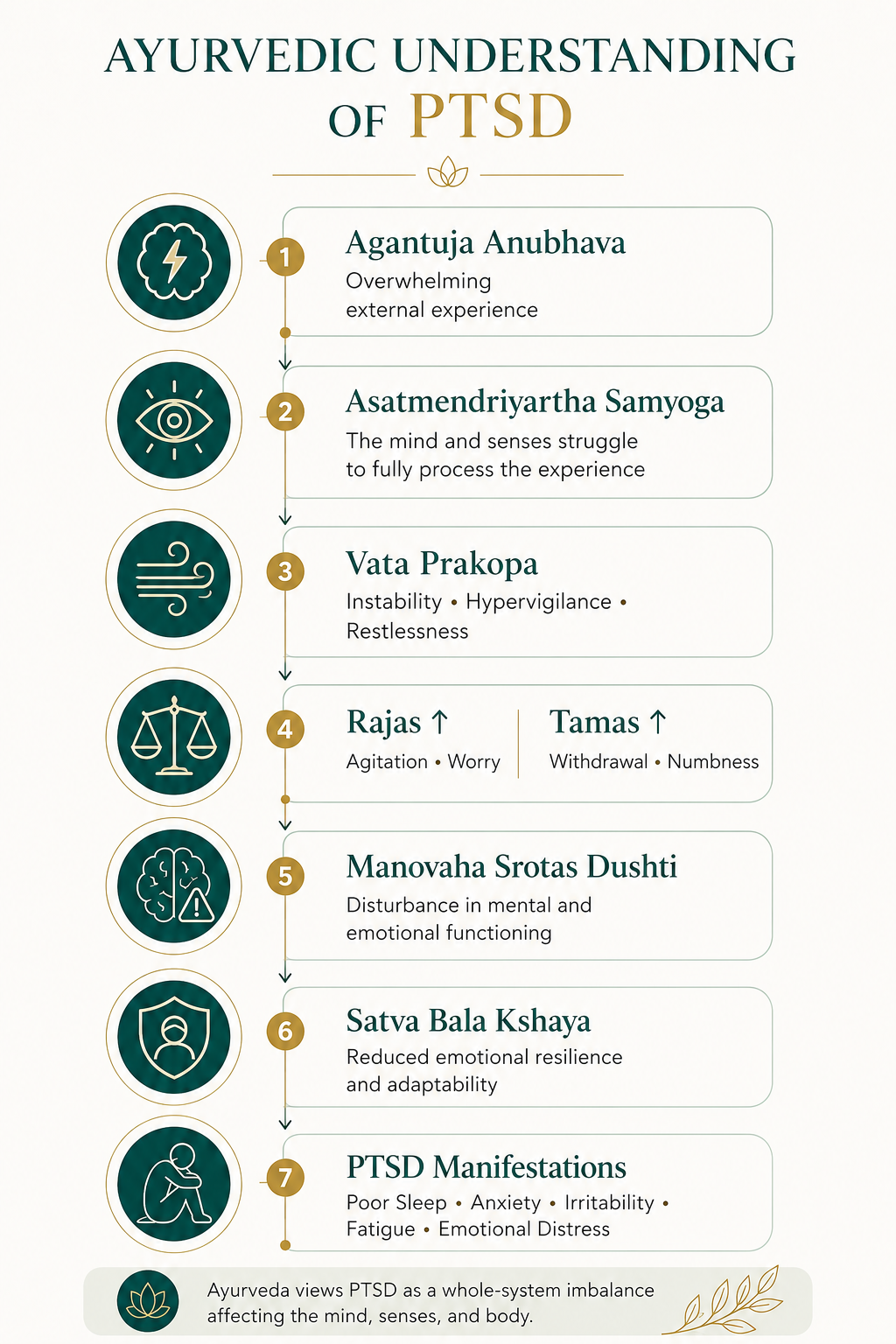
Ayurveda describes a concept known as Asatmendriyartha Samyoga. The phrase refers to an unhealthy or overwhelming interaction between the senses and what they experience. In simple terms, the mind and body are exposed to something they are unable to process comfortably or integrate fully.
Ayurveda broadly classifies trauma-related disturbances as an Agantuja Manovikara, meaning a condition that begins with an external event but gradually influences both mental and physical health. This becomes relevant in trauma because the experience may end, but its impact does not always end at the same time. A person may appear completely fine from the outside. Yet certain sights, sounds, situations, or memories can continue affecting a person long afterwards. A crowded room, an unexpected noise, or even a passing conversation may bring up feelings that seem far bigger than the moment itself. Many people find this frustrating because they thought they had already put the experience behind them. Ayurveda recognises that some experiences leave a deeper imprint on the system than others. When that imprint remains unresolved, the body may continue responding as though the threat is still present, even when the person consciously knows they are safe.
Bhaya, Shoka and the Lingering Effects of Emotional Distress
Bhaya (fear) and Shoka (grief) are recognised as experiences capable of influencing the entire individual rather than the mind alone. Fear tends to keep the system alert. People often describe it in simple ways. They finally have a quiet weekend, but still feel unable to relax. Their shoulders remain tense. Their minds continue scanning for problems even when none are immediately present. Grief often creates a different pattern. Energy declines. Motivation becomes harder to sustain. Recovery from everyday stress takes longer than expected. These changes usually develop gradually. Looking back, many people realise they have been carrying the effects of fear or grief for far longer than they initially recognised.
The Role of Vata in Trauma
When Ayurveda discusses experiences marked by fear, uncertainty, instability, shock, or sudden change,Vata often becomes central to the discussion. Vata governs movement throughout the body. It influences sensory processing, nervous system activity, communication, breathing, circulation, and sleep. When Vata is stable, people generally adapt to challenges more effectively. When it becomes disturbed, that adaptability begins to weaken.
A person may notice that they are more easily startled than before. Their minds remain busy long after the day has ended. Small disruptions seem disproportionately draining. Not everyone experiences this in the same way. Some become restless. Others feel depleted. Many move between the two states. This variability is one reason why trauma can be difficult to recognise. The symptoms do not always follow a predictable pattern, yet beneath them Ayurveda sees a common theme: the loss of internal stability that allows the system to feel settled and secure.
Over time, prolonged emotional strain may also affect Ojas, the principle associated with vitality, resilience, and the capacity to recover from challenges. People often struggle to describe this feeling. They are not necessarily unwell in an obvious sense, yet they no longer feel quite as steady, resilient, or energised as they once did.
Rajas, Tamas and the Emotional Landscape of Trauma
Ayurveda describes mental functioning through three Manogunas or mind qualities, known as Sattva, Rajas, and Tamas. Ayurveda regards Sattva as the foundation of a balanced mind, supporting clarity, stability, and sound judgment. When Sattva is strong, difficult experiences still hurt, but they do not completely take over a person’s ability to think clearly, make decisions, or stay connected to daily life. A person may feel fear, grief, or stress, yet still find their way back to balance. Trauma often makes it that much harder. Part of trauma healing in Ayurveda involves gradually strengthening Sattva again, so that life is no longer organised around fear, exhaustion, or constant alertness. This is one reason sattvik therapy for mental health remains an important concept within Ayurveda psychology.
While Sattva represents balance, Rajas and Tamas represent disturbed states of mind. When Rajas becomes dominant, the mind can feel as though it never quite settles. One worry leads to another. A small concern grows larger than it should. Even during moments that are objectively calm, there can be a feeling that something still needs attention. Tamas tends to look different. People often describe emotional heaviness, withdrawal, numbness, lack of motivation, or a sense of disconnection from life around them. In practice, these patterns frequently overlap. Someone may feel exhausted yet unable to relax. Another person may appear calm while carrying a great deal of internal distress. One of the challenges with trauma is that its effects are not always obvious, even to the person experiencing them. Reactions develop gradually. What begins as occasional difficulty sleeping may eventually affect energy, patience, confidence, and relationships. By the time someone recognises that something has changed, they may have been struggling for months or even years without connecting those changes to an earlier experience. In Manasika dosha treatment, these early shifts are not usually overlooked. Ayurveda pays attention to the small changes people often dismiss at first, because they can reveal a great deal about what the mind has been carrying.
Sattvavajaya Chikitsa and Recovery
Among Ayurveda’s approaches to mental well-being, Sattvavajaya Chikitsa holds particular significance. Often described as a method for strengthening and stabilising the mind, it includes principles such as Jnana (self-understanding), Vijnana (broader understanding), Dhairya (steadiness), Smriti (healthy integration of memory), and Samadhi (mental stability). What stands out about these ideas is how relevant they remain. Healing is not always about eliminating memories. Often, it involves changing the relationship a person has with those memories. Classical descriptions also emphasise reassurance, emotional support, guidance, encouragement, and helping a person regain perspective when distress has narrowed their view of life.
Ayurveda Support for Trauma Healing
Rather than focusing only on a diagnosis, Ayurveda assessment and treatment consider factors such as constitution, digestive strength, sleep patterns, emotional state, resilience, and the particular way symptoms are presenting in that person. Ayurveda approaches recovery through a combination of lifestyle, diet, therapies, and herbal support tailored to the individual. Among traditional herbs, brahmi for PTSD is frequently discussed because of its long association with mental clarity and emotional steadiness, though it is not meant for self-medication and is best used under guidance. Therapies such as shirodhara for trauma healing are also widely recognised. During the treatment, warm medicated oil is poured continuously over the forehead. Many people report a deep sense of calm during and after the procedure. Depending on the individual, Ayurvedic medicine for anxiety and stress may also form part of a broader treatment plan. Equally important are the foundations that support recovery every day: regular sleep, nourishing meals, supportive relationships, predictable routines, and opportunities for genuine rest.
Final Thoughts
Trauma does not always announce itself clearly. Sometimes it appears as poor sleep. Sometimes as anxiety. Sometimes as exhaustion that never seems fully explained. Ayurveda approaches these experiences by looking at the whole person rather than a single symptom. It considers the relationship between the mind, body, emotions, digestion, energy, sleep, resilience, and lived experience. Recovery is rarely dramatic. More often, it arrives quietly. A better night’s sleep. A calmer response to stress. A moment of ease that lasts a little longer than it did before. Over time, those small changes begin to accumulate. And for many people, that is where healing truly starts.
References